

Europe is on the brink of a major shift in circular legislation. The mattress industry will be among the first to feel its impact. The Netherlands, France and Belgium are already prepared: here, the circular mattress chain has been operating for years – living proof that it works. For other European countries, now is the moment to connect and prepare for what lies ahead.
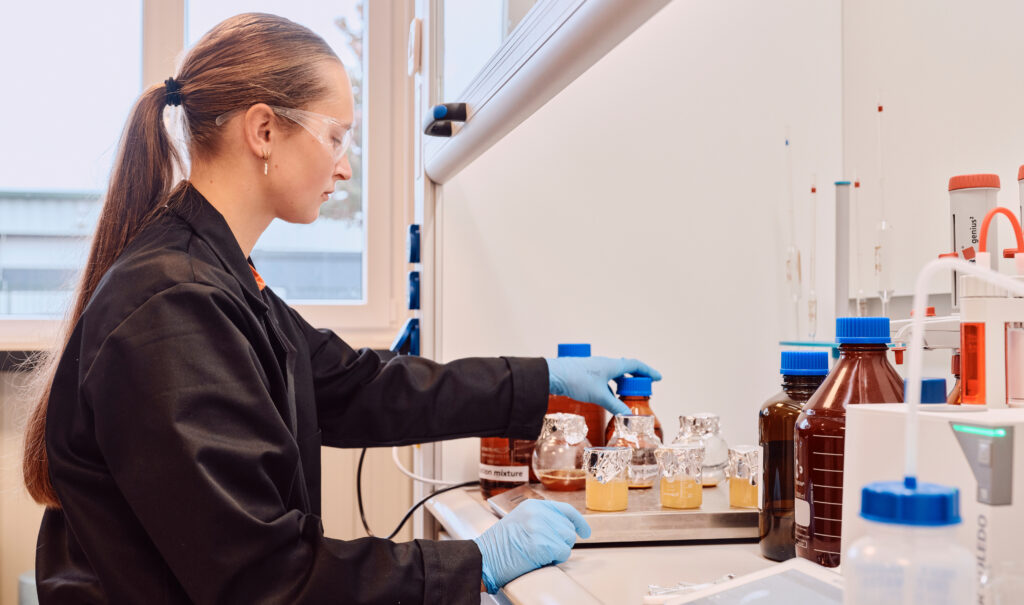
In CircuFoam’s laboratory in Lelystad, a viscous, golden liquid slowly drips from a pipette into a test tube. It looks like warm peanut butter, but this is RePoliol: liquid polyol made from end-of-life mattresses collected in France, Belgium and the Netherlands. Chemist Michal Ciolkowski tests every batch for viscosity, hydroxyl value and acid number before it is released from the factory. Today, a shipment is scheduled for Poland, where IKANO Industry blends the RePoliol with virgin polyol to produce new foam – the first step towards a new mattress containing recycled content.
100% reuse
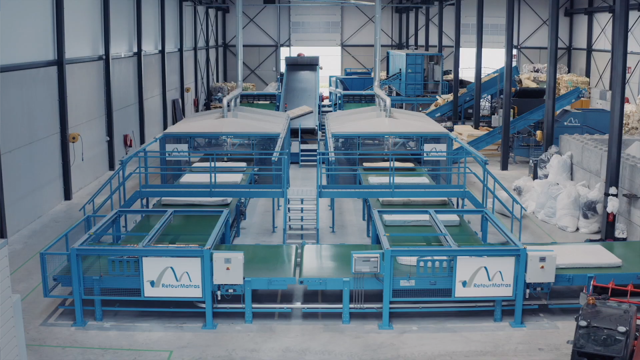
Outside, blue container trucks continuously arrive and depart, loaded with discarded mattresses. In the Netherlands alone, RetourMatras recycles more than one million mattresses each year. They are collected nationwide and dismantled at RetourMatras’ four Dutch dismantling facilities. The PU foam is sent directly to CircuFoam; the remaining components – such as textiles, pocket springs and latex — are separated into clean material streams. Here, 100% reuse is the guiding principle.
For many outside the sector, it is remarkable how smoothly this circular mattress chain has been operating for years. After all, formal mattress recycling legislation only came into force in 2018, while RetourMatras has been active since 2010. According to Managing Director Chico van Hemert, being ahead of legislation is in fact an advantage:
“The first legislation in the Netherlands applied to municipal recycling centres: from 2018 onwards, they were required to collect mattresses separately and keep them dry. That announcement alone was enough to set change in motion. When you know what’s coming and prepare in advance, you become a frontrunner. That’s how we’ve been operating for years.”
The shift goes European
The Netherlands, France and Belgium are now leading the way with clear regulation. In the Netherlands, the Extended Producer Responsibility (EPR) scheme for mattresses has been in place since 2021, requiring producers to contribute financially to national collection and recycling via the MRN foundation. Belgium and France introduced EPR schemes earlier – France as far back as 2012. Over the course of a decade, landfill disposal of mattresses there dropped from 100% to just 4%.
And then there is the ESPR: European legislation that will soon define how products must be designed and manufactured – including mandatory minimum shares of recycled content. The draft regulation for mattresses is expected in 2028 and is likely to come into force in 2029.

The circular chain is already operating
That may sound far off, but in CircuFoam’s Lelystad facility, it is already happening. Preparations are well underway with forward-thinking customers such as IKEA, Mitsan and IKANO Industry. Chico van Hemert explains:
“It’s rewarding to work with customers who share our pioneering mindset. Using raw materials recovered from old mattresses is not yet happening at scale — it requires significant investment, and the market is still uncertain. But sooner or later, it will become mandatory. Front-runners understand this. They are already testing RePoliol, ecodesign principles and other circular measures, such as the digital product passport.”
This is where the strength of a functioning circular chain becomes evident: you can see what works and what needs improvement. Many older mattresses are difficult to dismantle: stitched covers, foam layers glued together for transport, rolled-up products that make logistical sense but severely hinder material recovery. Pure material streams are still rare. Cross-border operations are further complicated by regulatory questions around classification: when does something cease to be waste and become a product?
Mattress manufacturers: now is the time to act
In practice, circularity works – but design and legislation must evolve together. Product design is the crucial link. A mattress that can be easily dismantled retains more value. A mattress made with reusable materials enables efficient recycling. And a mattress containing recycled polyol immediately reduces its CO₂ footprint.
Ultimately, that is what this is about: a healthier living environment, lower CO₂ emissions, and fewer raw materials extracted from the earth. As Chico van Hemert puts it:
“Mattresses are low-hanging fruit. Everyone sleeps on it, and everyone understands why reuse makes sense. With the right system, you can save tonnes of CO₂. But legislation, supply chain logistics and industrial design need to reinforce one another.”
Encouragingly, Chico sees this alignment starting to take shape: